Most beginner gardeners ask the same question when they start growing from seed: how often should I water my seedlings? And most of the answers they find online are dangerously oversimplified. “Every two days.” “Keep the soil moist.” “Water when the top inch is dry.” These rules sound helpful, but they ignore the most important factor — your specific setup.
The reality is that there is no universal watering schedule for seedlings. Watering too often drowns the roots. Watering too little stunts growth before it even begins. And once you understand what actually drives the right frequency, you’ll never stress about watering your seedlings again. Let’s break it down.
Why Watering Frequency Varies So Much
Two gardeners can be growing the exact same pepper variety, in the same type of soil mix, in pots of the same size — and one needs to water every day while the other waters every three or four days. How is that possible?
Because the rate at which soil dries out depends on a combination of factors that are completely unique to your environment:
Heat. A heating mat under your trays speeds up evaporation significantly. If you’re germinating seeds with bottom heat, your soil can go from moist to bone dry within 24 hours, especially in a small cell tray.
Light. Grow lights generate heat, which dries out the soil surface faster. Natural light from a window is usually gentler, which means slower evaporation.
Air circulation. If you have a fan running to strengthen your seedlings — which is good practice — it also pulls moisture out of the soil and the leaves much faster.
Pot size and material. Small cells dry out far more quickly than larger pots because there’s simply less soil to hold water. Terracotta pots lose moisture through their walls. Cardboard pots absorb some moisture themselves, which can make them feel deceptively dry on the outside while the inside is still fine.
Seedling size. A seedling that has just germinated needs very little water. A seedling with four or six true leaves has a much bigger root system actively drinking from the soil, so it depletes moisture faster.
Room temperature and humidity. A warm, dry room in winter with the heating on is very different from a cool basement or a humid greenhouse.
All of this is why counting days is the wrong approach. Instead, you need to learn how to read your soil.
The Three Checks That Replace Any Schedule – Know exactly how often to water seedlings
This is the core habit to build. Every morning, before you do anything else with your seedlings, run through these three checks. Together they take about five seconds, and they will tell you exactly what your plants need.
Check 1: Soil Color
This is your quickest, no-touch diagnostic. Look at the surface of your soil.
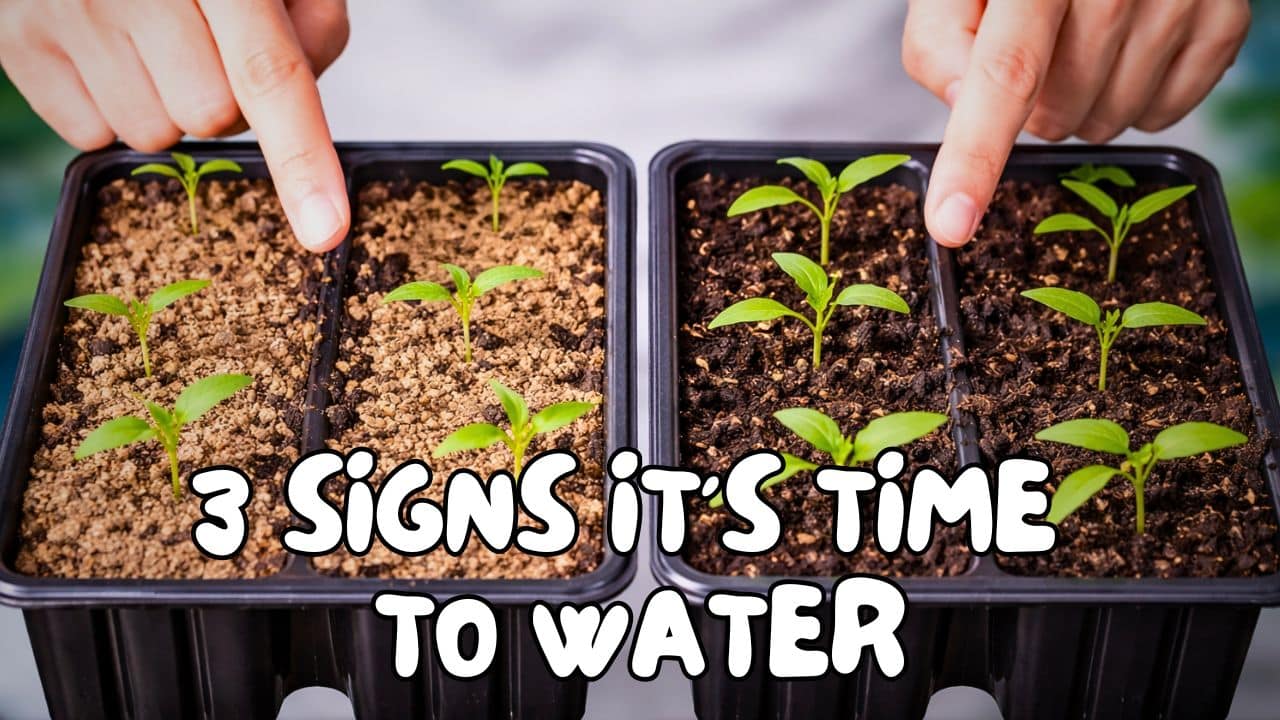
Dark brown means the soil is still holding moisture. Leave it alone.
Light brown or almost beige means the soil is dry and it’s time to water.
This color shift happens because water darkens soil particles. As they dry out, they lighten. Once you’ve seen this a few times, you’ll spot it instantly from across the room.
Check 2: The Finger Test
Push the tip of your finger about one centimeter into the soil — just below the surface. If it feels moist or cool, there’s still water in there and you can walk away. If it feels dry and crumbly, it’s time to water.
This test is useful because the surface can sometimes dry out faster than the deeper soil, especially under lights. The finger test tells you what’s actually happening where the roots are.
Check 3: The Weight Test
Pick up your pot, cell, or tray. Get a feel for how heavy it is.
A freshly watered pot is noticeably heavier than a dry one. When a pot feels light — almost like it’s empty — it’s dry. When it feels substantial and heavy, water is still present.
This one takes a little practice, but after a few days it becomes pure instinct. You won’t even need to think about it — you’ll just pick something up and know immediately. It’s particularly useful for cardboard pots, where the exterior can feel dry even when the interior is still holding moisture.
Run these three checks every morning. That’s your watering schedule. No app, no timer, no fixed number of days.
How to Actually Water Seedlings: Two Methods
Knowing when to water is half the battle. Knowing how to water is the other half — and the method changes depending on the stage your seedlings are at.
Spray Bottle: For the Very Beginning
When you’ve just sown seeds and nothing has sprouted yet, or when your seedlings have just emerged and are still tiny and fragile, use a spray bottle.
The reason is simple: at this stage, the seeds and sprouts are extremely delicate. A direct stream of water from a watering can or cup can:
- Physically move a seed deeper into the soil or to the side, disrupting germination
- Knock over a fragile sprout that hasn’t developed a proper root system yet
- Create channels in the soil that disrupt even moisture distribution
A fine mist from a spray bottle wets the surface gently without disturbing anything. Mist the surface until it looks dark and evenly moist, without water pooling.
The limitation of a spray bottle is that it only wets the top layer of soil. For tiny seedlings that are just getting started, that’s fine — their roots are near the surface anyway.
Bottom Watering: Once True Leaves Appear
Once your seedlings have developed their first set of true leaves (not the initial seed leaves, but the first real leaves that come after), it’s time to switch to bottom watering.
Here’s why: by this point, your seedling’s roots have started growing downward in search of water and nutrients. If you only ever water from the top with a spray bottle, you’re only wetting the surface — and you’re training the roots to stay shallow. Bottom watering solves this.
How to bottom water:
- Place your seedling tray or pot in a larger container or tray filled with about 2 centimeters of water.
- Wait 10 to 15 minutes. The soil will draw water upward through capillary action, wetting evenly from the bottom up.
- Remove the tray and let any excess water drain off.
- Empty whatever water is left in the bottom tray. This is critical. Never leave your pots sitting in standing water — that’s one of the fastest ways to develop root rot, which will kill your seedlings.
Bottom watering has two major advantages beyond just reaching the roots: it encourages roots to grow downward in search of moisture, which creates a stronger, more resilient plant. And it keeps the surface of the soil drier, which reduces the risk of damping off — a fungal disease that attacks seedlings at the soil line and is encouraged by consistently wet surfaces.
Common Mistakes to Avoid
Watering on a fixed schedule. As we’ve covered, this is the most common mistake. Your soil doesn’t care what day it is.
Watering a little every day. Many beginners give their seedlings a small amount of water daily because it feels attentive and careful. In reality, light, frequent surface watering encourages shallow root growth and keeps the soil surface constantly moist, which increases the risk of fungal problems. It’s better to water thoroughly when the soil actually needs it, then let it dry out partially before watering again.
Leaving water in the bottom tray. After bottom watering, always empty the tray. Roots sitting in standing water will suffocate and rot.
Ignoring the pot material. Cardboard pots, as mentioned, behave differently from plastic. Always use the weight test as your primary check with cardboard, since the surface can mislead you.
Overwatering out of worry. Seedlings are surprisingly resilient to being slightly dry, far more so than they are to being waterlogged. If you’re unsure, wait another hour and check again. When in doubt, don’t water yet.
Watering seedlings properly isn’t about following a schedule. It’s about developing a daily habit of observation. Check the color, check the texture, feel the weight. Do this every morning and you will always know what your seedlings need.
Use a spray bottle while they’re tiny and fragile. Switch to bottom watering once true leaves appear. Never leave standing water in the tray. And stop worrying about whether you watered yesterday or two days ago — your soil will tell you everything you need to know.