Most gardening advice revolves around sun-drenched spaces — south-facing beds, bright patios, open rooftops. But the reality for millions of gardeners is quite different: a north-facing balcony, a shaded courtyard, a spot under a large tree, or a covered porch. If that sounds familiar, you’re not out of luck. Container gardening in shade is not only possible — it can be genuinely beautiful, lush, and productive.
This guide walks you through everything you need to know to grow stunning containers in low-light conditions.
Understanding Shade: Not All Shadows Are Equal
Before diving into plants and pots, it’s worth understanding what “shade” actually means in gardening terms. There’s a big difference between a spot that receives zero sunlight all day and one that gets a couple of hours of morning sun.
Full shade means fewer than 2 hours of direct sunlight per day. Think of the area beneath a dense canopy or the north side of a tall building. This is the most challenging environment, but still workable with the right plants.
Partial shade (also called semi-shade) typically means 2 to 4 hours of direct sun, often in the morning or late afternoon, with dappled light in between. This is actually quite manageable and opens up a wide range of possibilities.
Dappled shade refers to filtered sunlight through tree leaves — it shifts throughout the day and can mimic the conditions of a forest floor. Many woodland plants thrive in exactly this type of light.
Take time to observe your space across a full day before choosing your plants. What looks like “full shade” in the morning might catch 3 hours of direct afternoon sun — or vice versa.
Why Containers Work Particularly Well in Shaded Spaces
Shaded gardens often come with their own set of challenges beyond light: compacted soil under tree roots, dry patches where an overhang blocks rain, or hard surfaces like concrete or stone. Containers sidestep most of these issues elegantly.
With pots and planters, you control the growing medium entirely, ensuring good drainage and the right nutrient balance regardless of what lies beneath. You can also move containers seasonally to chase what little light is available, rotate them to give all sides equal exposure, and group them together to create a microclimate of higher humidity — something shade-loving plants tend to appreciate.
Containers also allow you to be creative in a shaded environment that might otherwise feel dull. A cluster of richly textured foliage plants in varied pots can transform a dim corner into a dramatic focal point.
Choosing the Right Containers
In shady conditions, soil tends to stay moist longer since there’s less evaporation from sun and heat. This has real implications for your choice of container.
Drainage is non-negotiable. Any pot without drainage holes will almost certainly lead to waterlogged roots in a shady spot. Make sure every container has at least one hole at the bottom, and consider placing pots on feet or risers to allow water to escape freely.
Material matters. Terracotta pots, while beautiful, dry out quickly — which is actually less of a problem in shade, but they can also become cold and damp in low-light spots during winter, potentially damaging roots. Plastic, resin, and fiberglass pots retain moisture more evenly and are lighter if you need to move them. Glazed ceramic pots offer a good middle ground: attractive, sturdy, and reasonably moisture-retentive.
Size up when possible. Larger containers hold more soil, which means more stable moisture levels and more room for roots. A 12-inch pot might sustain a single fern, but a large 18–24 inch planter could host a whole composition of shade-loving plants.
The Best Compost and Soil Mix for Shaded Containers
Shade-loving plants often come from forest understory environments where the soil is rich in organic matter, well-draining but moisture-retentive, and slightly acidic. You can replicate this with a thoughtful mix.
A good all-purpose recipe for shaded containers is roughly two parts peat-free multipurpose compost, one part perlite or horticultural grit for drainage, and one part leaf mold or well-rotted bark. This gives you a light, airy medium that holds moisture without becoming waterlogged — exactly what most shade plants need.
If you’re growing ericaceous (acid-loving) plants like ferns, pieris, or rhododendrons in containers, swap the standard compost for an ericaceous mix.
Refresh the top few inches of compost each spring and add a slow-release fertilizer. Since shaded areas get less sun, plants grow more slowly and need fewer nutrients overall — but they still benefit from a light feed in spring and summer.
Best Plants for Shaded Containers
This is where container gardening in shade gets exciting. There is a remarkable range of plants that not only tolerate low light — they actively prefer it. Here’s a tour of the best options across different categories.
Foliage Stars
In shade, foliage does much of the heavy lifting. The good news is that shade plants often have the most dramatic, textured leaves you’ll find anywhere in the garden.
Hostas are the undisputed kings of shade foliage. Available in hundreds of varieties, they range from tiny miniatures to enormous plants with leaves spanning 30cm or more. Colors run from deep blue-green to chartreuse to pure white, and many are beautifully variegated. Hostas are reliably perennial and look increasingly dramatic as they fill out over the years. Just watch for slugs.
Heucheras (coral bells) offer year-round interest with their richly colored foliage in shades of deep burgundy, caramel, lime green, and silver. They’re evergreen in mild climates and hold their leaves through winter, making them reliable container performers.
Astilbes bring feathery plumes of flowers in summer — in pink, red, white, or lilac — and lovely ferny foliage throughout the season. They do well in partial shade and enjoy moist soil, making them ideal for shaded containers that stay damp.
Ferns are perhaps the most classic shade plants of all. Varieties like the Japanese painted fern (Athyrium niponicum), the soft shield fern (Polystichum setiferum), or the dramatic black tree fern (Dicksonia antarctica) bring incredible texture. Many are evergreen, offering structure year-round.
Caladiums are tender perennials (treat them as annuals in cooler climates) with heart-shaped leaves in spectacular combinations of white, pink, red, and green. They thrive in warm shade and are among the most visually striking plants you can grow in a container.
Flowers That Bloom in Shade
Flowering shade plants exist — and several of them are remarkable.
Begonias are one of the most reliable choices for shaded containers. Both tuberous and fibrous (wax) begonias bloom prolifically with minimal fuss in partial shade. Trailing varieties like Begonia boliviensis hybrids create spectacular cascades of warm-toned flowers all summer.
Impatiens remain one of the most popular summer bedding plants precisely because they bloom abundantly without needing much sun. Available in a rainbow of colors, they flower continuously from late spring to first frost.
Fuchsias are spectacular in hanging baskets or tall containers in dappled shade. Their pendulous two-toned flowers are unlike anything else in the garden and they bloom reliably throughout summer.
Hydrangeas — particularly the mophead and lacecap types — handle partial shade gracefully and make dramatic container specimens when young. Their large flower heads last for weeks.
Lily of the valley (Convallaria majalis) is a charming woodland plant with iconic white bell-shaped flowers in spring. It spreads in the ground but behaves nicely in containers.
Edibles for Shaded Containers
Growing food in shade is more limited than in full sun, but certain edibles do well with just a few hours of light.
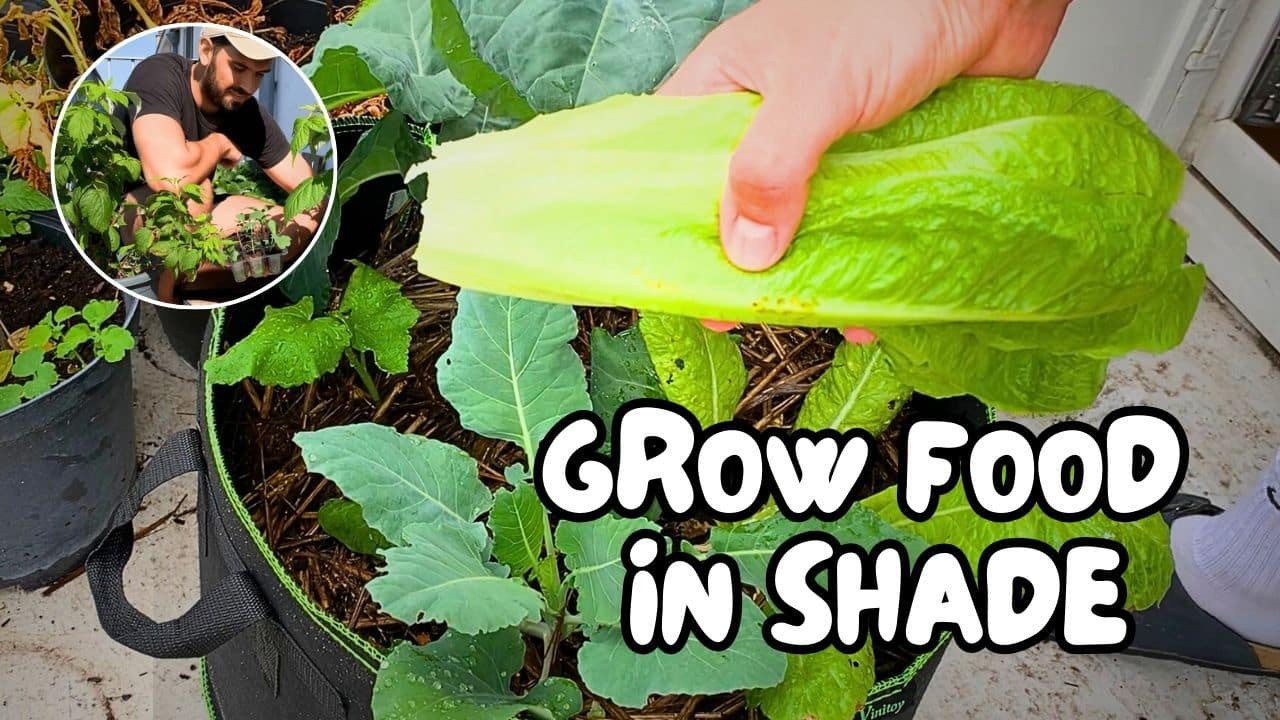
Leafy greens — lettuce, spinach, chard, kale, and rocket — actually prefer to be out of the hottest sun and will grow in partial shade, often with less bolting than in full sun.
Mint is vigorous in shade and almost prefers being contained in a pot, where it can’t take over the garden.
Chives tolerate partial shade and are useful in the kitchen year-round.
Parsley grows reliably with just 2–3 hours of light per day.
Strawberries are a surprisingly good choice for shaded containers. While they won’t produce quite as abundantly as in full sun, alpine strawberry varieties (Fragaria vesca) are specifically bred for woodland conditions and will fruit reliably in partial shade. Their compact size makes them ideal for window boxes or hanging baskets, and the bonus is that shade slows down fruiting slightly, giving you a longer harvest window over the season.
Don’t expect tomatoes or peppers to fruit in shade, but for a salad garden on a north-facing balcony, containers of leafy greens can be wonderfully productive.
Watering and Maintenance in Shade
Overwatering is the most common mistake in shaded container gardens. With less sun and wind to dry things out, soil stays moist far longer than it would in a sunny spot. Always check the soil with your finger before watering — if the top inch or two is still damp, wait another day or two.
That said, spots under overhangs or dense tree canopies can be surprisingly dry, since rain never reaches them directly. Check these containers more carefully; they may need regular watering even in wet weather.
Remove spent flowers regularly to encourage continued blooming, and trim back any yellowing or damaged leaves to keep containers looking tidy. Feed with a balanced liquid fertilizer every two to three weeks during the growing season — avoid high-nitrogen formulas, which push leafy growth at the expense of flowers.
In winter, consider moving tender plants indoors, wrapping pots in horticultural fleece to protect roots from frost, and replacing summer annuals with hardy evergreens like ferns, winter-flowering pansies, or hellebores.
A shaded spot is not a gardening dead-end — it’s an invitation to explore a different palette of plants, one that rewards attention to texture, form, and the subtleties of color. Container gardening in shade gives you the flexibility to experiment, move things around, and craft a garden that works beautifully within the light you actually have rather than the light you wish you had.
Start with a few well-chosen containers and a mix of reliable plants — a hosta, a heuchera, a trailing begonia — and build from there. You’ll likely find that your shaded corner becomes one of the most interesting and tranquil spaces in your entire garden.